

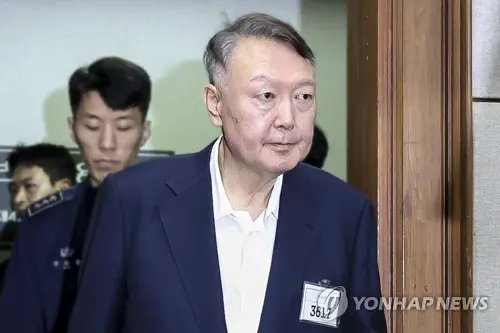
A Seoul court on Thursday acquitted former President Yoon Suk Yeol of perjury charges related to his testimony during the insurrection trial of former Prime Minister Han Duck-soo. The ruling, delivered by the Seoul Central District Court, marks a significant legal victory for Yoon, who remains in custody on other charges. The court found that Yoon's testimony did not meet the legal threshold for perjury, as it could not be proven that he intentionally gave false information contrary to his own memory.
The perjury case centered on a Cabinet meeting that Yoon convened shortly before declaring martial law on December 3, 2024. During Han's trial in November, Yoon testified as a witness and was asked whether Han had proposed holding the meeting to make the martial law declaration appear procedurally lawful. Yoon responded angrily, stating, "Cabinet members are not dolls who come to create an outward appearance," and insisted that the meeting was planned independently. The special counsel team, led by Cho Eun-suk, argued that Yoon initially had no intention of holding a Cabinet meeting and only changed his mind after Han's suggestion. They contended that Yoon called in additional Cabinet members, including then-Deputy Prime Minister Choi Sang-mok, solely to meet the quorum after Han's input.
However, the court ruled that there was a "high possibility" that Yoon had already planned to convene the Cabinet meeting regardless of Han's proposal. The judges noted that documents for Choi had been prepared in advance, suggesting that Yoon intended to meet Cabinet members in phases. "It is difficult to view the testimony as contrary to his memory of the facts," the court said in its verdict. "Therefore, it is not subject to a perjury charge." The ruling effectively dismissed the special counsel's request for a two-year prison sentence.
Background of Yoon's Legal Turmoil
Yoon Suk Yeol, a former prosecutor general, served as South Korea's president from 2022 until his impeachment in July 2024. He was removed from office following his declaration of martial law, which the National Assembly swiftly overturned. The impeachment led to his arrest on charges of leading an insurrection, and he has been held in custody since July 2024. In February 2025, a first-instance trial sentenced him to life imprisonment for insurrection, a verdict currently under appeal. Yoon's legal battles also include corruption allegations involving his wife, Kim Keon Hee, and the 2023 death of a Marine during a training exercise.
The perjury acquittal is a rare reprieve for Yoon, who faces a total of eight ongoing trials. His defense team has consistently argued that the charges are politically motivated, aimed at discrediting him after his impeachment. In a Facebook post following the verdict, one of Yoon's lawyers expressed gratitude to the court, stating that the ruling "upheld the truth." Meanwhile, the special counsel team announced it would review the ruling before deciding whether to appeal.
Details of the Perjury Charge
The perjury indictment stemmed from Yoon's testimony in Han Duck-soo's trial. Han, who served as prime minister under Yoon, was also implicated in the martial law declaration. During the trial, the prosecution sought to establish that the Cabinet meeting was a facade designed to legitimize an unconstitutional act. Yoon, appearing as a witness, vehemently denied that Han had influenced his decision. "I had already decided to hold the meeting," Yoon testified. "The suggestion from the prime minister did not change my plans." The special counsel team countered by presenting evidence that Yoon had not scheduled any Cabinet meeting until Han raised the issue. They claimed that Yoon's testimony created a false impression that the meeting was premeditated.
The court, however, found the evidence insufficient to prove Yoon's intent to deceive. Legal experts noted that perjury requires a clear demonstration that the witness knowingly gave false testimony. In this case, the court concluded that Yoon's statement was consistent with his own recollection, even if that recollection might be inaccurate. "The burden of proof for perjury is high," said Professor Kim Dong-hyun of Seoul National University Law School. "The court showed that it cannot punish a witness simply for having a flawed memory."
Implications for Yoon's Other Trials
While the acquittal removes one legal hurdle, Yoon still faces substantial challenges. The life sentence for insurrection remains the most serious charge, and the perjury verdict does not affect that case. However, the ruling could bolster Yoon's defense in other proceedings by undermining the credibility of the special counsel team. Yoon's lawyers are expected to cite the acquittal as evidence that the prosecution is overreaching. The perjury case also highlights the contentious nature of Yoon's testimony in Han's trial, which could be used in future appeals.
Yoon's wife, Kim Keon Hee, is under investigation for alleged influence-peddling and stock manipulation. Additionally, the death of Marine Corporal Chae Su-geun during a search-and-rescue operation in 2023 has led to accusations that Yoon's administration interfered with the investigation. These cases, combined with the martial law insurrection charges, have kept Yoon at the center of South Korea's political turmoil.
Political and Public Reaction
The acquittal has drawn mixed reactions. Supporters of Yoon gathered outside the courthouse, waving flags and chanting slogans. "This proves that President Yoon is being wrongly persecuted," said one protester. Opponents, however, expressed disappointment, arguing that the court failed to hold Yoon accountable for what they see as a broader pattern of deception. "The special counsel team presented clear evidence that Yoon lied," said Park Ji-won, a member of the opposition Democratic Party. "This ruling sets a dangerous precedent." The special counsel team, led by Cho Eun-suk, has 14 days to appeal the verdict. Legal analysts expect an appeal, given the high-profile nature of the case and the potential impact on Yoon's legacy.
The perjury trial also shed light on the inner workings of Yoon's administration during the martial law crisis. Testimony from former Cabinet members revealed deep divisions within the government. Some officials claimed they were pressured to support the declaration, while others said they were kept in the dark about Yoon's plans. The court's decision to acquit Yoon on the perjury charge does not resolve these questions, but it does suggest that the judiciary is cautious about criminalizing political disputes.
Yoon remains in custody at the Seoul Detention Center, where he continues to meet with his legal team. His life sentence for insurrection is under appeal, and a second trial on corruption charges is scheduled for later this year. The perjury acquittal may provide a temporary morale boost, but Yoon's long-term future remains uncertain.
Source: Yonhap News Agency News