

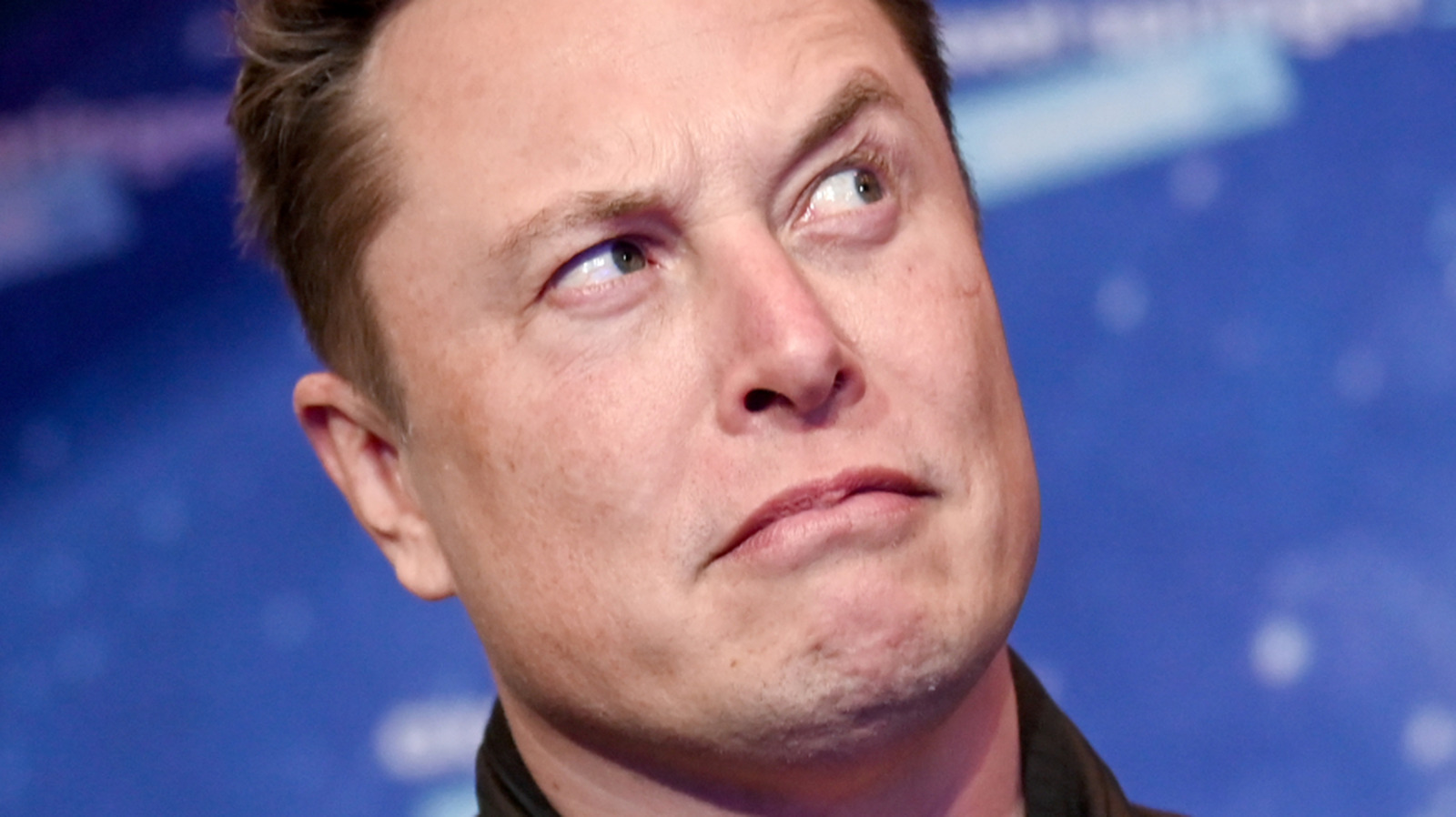
Elon Musk, at times the world's richest man, is certainly one of its most discussed. After making a name for himself at PayPal, he would go on to buy his way into the already-established Tesla Motors company, becoming an industry leader in electric vehicles. Unable to be constrained by Earth or its gravity, his next venture was SpaceX, and Musk became a leader in private space exploration.
For years, Musk was hailed as a visionary who would help end the era of fossil fuels and might even propel humanity to other planets. He was even a partial inspiration for the character of Tony Stark in the Marvel Cinematic Universe, to whom he has often been compared.
But with wild success comes wild failure, and Musk's past is riddled with it. From being forced out of his own company to costly business mismanagement, and even seeing his creations crash or explode, here are Elon Musk's biggest tech failures that no one talks about.
He was fired from PayPal
- Musk founded X.com in 1999, which merged with Confinity (maker of PayPal).
- Employees threatened to resign if Musk didn't step down as CEO while he was on his honeymoon in 2000.
- Board forced Musk out and replaced him with Peter Thiel.
- Company renamed PayPal and later sold to eBay for $1.5 billion.
One of Elon Musk's earliest successes came with the financial services website X.com, which he founded by investing money from his first company, Zip2, after it was purchased by Compaq. The merger with Confinity brought PayPal into the fold, but Musk's aggressive leadership style clashed with employees. The coup against him happened swiftly, marking the first major setback in his career. Although Musk remained a major shareholder and profited from the eBay sale, the incident highlighted his difficulty with collaborative management.
He waged war against a Tesla whistleblower
- In 2018, assembly worker Martin Tripp reported wasteful practices at Tesla's Gigafactory.
- Musk ignored the concerns, then fired Tripp and sued him for $167 million.
- Private investigators tailed Tripp and hacked his phone.
- Musk's security team falsely claimed Tripp planned a mass shooting, leading to a SWAT raid.
One of the least discussed but most revealing chapters in Musk's history came in 2018 when a Tesla assembly worker named Martin Tripp noticed some concerning things at Tesla's Gigafactory in California. Tripp identified a number of wasteful practices in production, so he brought his concerns to Musk, who proved unreceptive. Tripp next brought internal Tesla documents to Business Insider, but in response, Musk waged war against the leaker, as detailed in a Bloomberg investigation. He fired Tripp, then sued him for $167 million. He hired private investigators who tailed him in person and hacked his phone to see his texts in real-time. On his alleged orders, Tesla's security team passed along a tip to police claiming that Tripp was planning to commit a mass shooting at the factory. The SWAT team deployed to Tripp's house found him unarmed and sobbing. The overreaction not only damaged Musk's reputation but also highlighted how the company failed to handle internal concerns effectively, a pattern that would continue.
Under his management, Tesla covered up safety violations, workplace injuries, and racism
- California OSHA investigated Tesla 24 times between 2014 and 2018, fining for 54 violations.
- Tesla covered up hundreds of factory-related injuries since 2015 (LATimes).
- In 2022, a Black contractor won $15 million for discrimination.
- Fifteen Black employees filed a lawsuit alleging racial harassment and promotion bias.
In 2019, Forbes found that Tesla had been investigated by California OSHA 24 times between 2014 and 2018 and was fined for 54 violations. One worker lost a finger after his glove was caught in a torque gun. There were eight investigations at Tesla's Tennessee factory with five violations found, and the one in Kentucky was investigated 13 times with four violations issued. In 2020, the Los Angeles Times reported that Tesla had covered up hundreds of factory-related injuries since 2015. Then, a judge ruled in April 2022 that Tesla must pay out $15 million to a Black contract worker who was systematically discriminated against inside the company. In July of that year, fifteen Black employees, both former and current, filed a lawsuit alleging they were racially harassed with slurs, compared to chattel slaves, and assigned to the most physically exhaustive labor while being passed over for promotions. Given Elon Musk's iron grip over his companies, the buck stops with him. When factories are this chaotic, is it really surprising we have yet to see deliveries of the Tesla Roadster or Cybertruck?
Under his management, a shocking number of SpaceX rockets have exploded
- At least 10 SpaceX rockets combusted between 2014 and 2021 (NYPost).
- Falcon 9 exploded over Atlantic in 2015, costing $112 million.
- Another Falcon 9 carrying ISS cargo exploded two minutes after liftoff in 2015.
- Musk investigated one launch pad explosion as possible sabotage.
- Debris from a crash landed on Australian farms in 2022.
After Tesla's success in the years after Elon Musk bought his way into the company, the billionaire's next venture left the road behind in favor of the stars. SpaceX, the private, Musk-controlled spacecraft and satellite manufacturer has become one of the leaders in space technology and was even the first private company to develop a liquid-propellant rocket that achieved Earth orbit when it launched the Falcon 1 in 2008. But despite its successes, a surprising number of SpaceX rockets have gone down in flames — according to reports, at least 10 rockets have combusted between 2014 and 2021. Indeed, many of SpaceX's rockets have become nothing more than incredibly expensive fireworks, such as a Falcon 9 that exploded over the Atlantic Ocean in 2015, costing the company an estimated $112 million. Another Falcon 9 carrying cargo bound for the International Space Station combusted two minutes after liftoff that same year. Among the most spectacular failures was a Falcon 9 rocket that exploded on the launch pad, a failure so mind-boggling to Musk that he investigated it as a case of sabotage. At times, these technological failures can even present a threat to those of us who are terrestrially bound. In August 2022, two Australian farmers found debris from a SpaceX crash on their respective properties.
He got in trouble with the FCC over rigging Tesla stock prices with a joke
- In 2018, Musk tweeted about taking Tesla private at $420 per share, causing stock spike.
- SEC charged him with civil securities fraud; investors sued.
- Musk settled with SEC for $20 million and agreed to have Tesla-related tweets vetted.
- In 2022, Musk fought to kill the SEC settlement, citing free speech.
Elon Musk has always considered himself a bit of a troll, and nothing tickles his posting syndrome more than a weed joke. But in 2018, Musk's stoner antics backfired when he made what may just be the world's costliest 420 joke. On Twitter, the billionaire posted, "considering taking Tesla private at $420 a share." Laughs were had. Yuks were yukked. And then the Securities and Exchange Commission (SEC) got involved. Musk's proposed share price may have been intended in jest, but he seemed serious about taking Tesla private, and his announcement, which suggested a valuation 11% higher than the current trading price at that time, caused a sudden spike in Tesla's stock prices and trading was halted by Nasdaq. The SEC charged him with civil securities fraud. Investors sued, and a judge ruled that Musk had made intentionally false statements; he had been lying, to begin with. In 2019, Musk settled with the SEC, landing on an arrangement that included personally paying $20 million — pocket change for a man like Musk — and agreeing to have any tweets about Tesla vetted by the company's legal counsel before posting them. Though it was regarded as a slap on the wrist by experts, Musk filed to kill the SEC deal in 2022, accusing the regulating body of violating his free speech.
Under Musk's management, over 270 Tesla vehicles crashed on Autopilot in one year
- Between June 2021 and June 2022, 273 Teslas crashed while in Autopilot mode.
- This accounted for nearly 70% of all crashes involving driver-assistance systems (NHTSA).
- Autopilot is not fully autonomous, but Musk's exaggerated promises lead to driver misuse.
- Other automakers avoid such hyperbole about self-driving capabilities.
While many of Elon Musk's technological failures represent setbacks for his companies or for himself, personally, others have had much more dire consequences. Nothing is more representative of that fact than the staggering number of Tesla cars that have been involved in crashes while in Autopilot mode. Between June 2021 and June 2022, a staggering 273 Teslas were involved in crashes while in Autopilot mode, accounting for almost 70% of crashes that involved driver-assistance systems according to the National Highway Traffic Safety Administration. Tesla's Autopilot is, despite what its name suggests, not meant to drive the car fully autonomously. Rather, it is a suite of driver-assistance features that help the vehicle maintain speed, make safe lane switches, and the like. Although a beta of "Full Self Driving" mode is available on some models, it is not reliable enough to allow drivers to divert their attention from the road. But that doesn't stop some Tesla drivers from doing so anyway, perhaps trusting Musk's exaggerated promises about the technology. When that technology fails, the results can be deadly, which is probably why other auto manufacturers avoid such hyperbole about their own vehicles' self-driving capabilities.
He brought Tesla and SpaceX to the verge of bankruptcy
- Tesla was within a month of bankruptcy during Model 3 production hell (mid-2017 to mid-2019).
- SpaceX faced bankruptcy in 2021 due to Raptor rocket production crisis.
- Both companies recovered, but the near-misses are often glossed over.
As the head of two companies that manufacture, respectively, automobiles and rockets, tech issues can be costly. And as the head of both Tesla and SpaceX, both companies came dangerously close to the precipice of bankruptcy under Elon Musk's leadership. In the case of Tesla, the issues came while the company was in the production of its Model 3 electric sedan. Musk shared on Twitter that, from mid-2017 to mid-2019, Tesla was within a month of bankruptcy as production on their vehicles stalled. The CEO named "production and logistics hell" as the culprit. Then, in 2021, SpaceX nearly exploded into financial flames like a failed rocket launch. The problem was, similarly, production issues with its Raptor rockets. In a companywide email, Musk warned his employees at the space technology firm, "The Raptor production crisis is much worse than it seemed a few weeks ago. We face genuine risk of bankruptcy if we cannot achieve a Starship flight rate of at least once every two weeks next year." Ultimately, both companies overcame their technological difficulties, and their respective near bankruptcies became another in a long list of Musk's least publicized failures.
His Starlink satellites became Russian military targets
- Starlink satellites provided communications backbone for Ukraine during Russian invasion.
- Ukraine used them for photography, damage assessment, and evidence of mass graves.
- Russia threatened to target "quasi-civilian infrastructure" – likely Starlink.
Russia's invasion of Ukraine has dominated the news cycle, and Elon Musk has played a surprisingly key role in the ongoing conflict. Starlink satellites provided by SpaceX formed the backbone of Ukraine's communications network, helping its armed forces and civilians as Russia pummeled the country's ground infrastructure. The satellites were subsidized by the United States, though SpaceX representatives have framed it as a charity operation. Aside from their invaluable role in Ukraine's communications, the besieged nation uses the satellites provided by Musk's company to photograph Russian military deployments, review damage done to its enemy's air bases, and even provide grim evidence of mass graves in Russian-occupied territory. In September 2022, the Russian delegation to the U.N. General Assembly released a statement promising that "quasi-civilian infrastructure" could be a "legitimate target" if Ukraine continues to use them, almost certainly referring to SpaceX's Starlink Satellites. But as dire as the situation was, it was about to escalate due to Musk's own actions.
He threatened Ukraine but was forced to back down
- In October 2022, Musk threatened to stop funding Starlink for Ukraine after a Ukrainian diplomat insulted him.
- The move would have crippled Ukraine's defenses against Russia.
- Musk reversed his threat after international backlash; SpaceX had only donated 3,000 of the 20,000 satellites used.
In October 2022, as the Russo-Ukrainian war waged on, Musk abruptly threatened to cease funding the use of Starlink satellites by Ukraine. Given the nation's heavy reliance on those satellites for its war efforts, such a move would have crippled Ukraine's defenses and provided a major tactical advantage to Russia. Even more shockingly, the threat seemed to be a response to a Ukrainian ambassador who insulted him on Twitter. After Musk ran a Twitter poll suggesting the conflict be ended via a UN-supervised vote, and that the contested Crimea region remain part of Russia, Andrij Melnyk, Ukraine's ambassador to Germany, told Musk, "[Expletive] off is my very diplomatic reply to you." Shortly after threatening to cut Ukraine off from the Starlink network, Musk tweeted, "We're just following his recommendation." But only a day later, Musk rescinded his threat, promising to continue funding with a bitter tweet that read, "The hell with it ... even though Starlink is still losing money & other companies are getting billions of taxpayer $, we'll just keep funding Ukraine govt for free." The Times speculated that Musk's about-face was in response to international rebuke for his threat, and noted that SpaceX had only donated 3,000 satellites to the Ukrainian effort, while the United States, the United Kingdom, and Poland footed the bill for almost 17,000. The incident was a bizarre instance of a tech company becoming mired in international geopolitics, and the world may never know how close Musk came to handing Russia its desired annexation of Ukraine.
Source: SlashGear News