

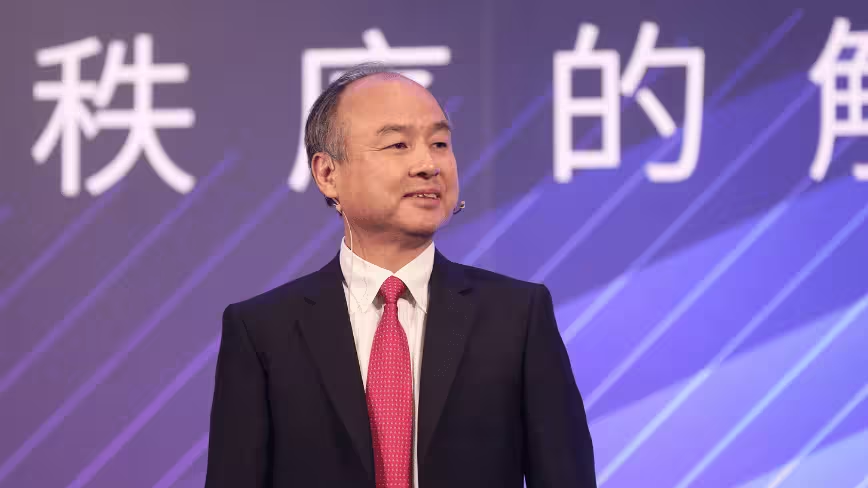
SoftBank Group has announced plans to convert part of a former Sharp LCD factory in Sakai, Osaka, into one of Japan's largest battery production lines. The batteries will be used to power the company's own AI data centres, which are currently under construction. The site, purchased last year for about $676 million, was originally intended to become an AI data centre itself. Now, a portion of the 440,000-square-metre facility will be repurposed for large-scale energy storage manufacturing.
The decision marks a significant strategic step for SoftBank as it seeks to vertically integrate its AI infrastructure operations. The company now owns chip architecture firm Arm, AI chip designers Graphcore and Ampere Computing, and is building modular data centre units at a former electric vehicle plant in Lordstown, Ohio. Its energy subsidiary, SB Energy, operates over three gigawatts of solar capacity in the US with a pipeline exceeding 15 gigawatts of solar and 12 gigawatt-hours of storage. By manufacturing its own batteries, SoftBank aims to reduce reliance on external suppliers like CATL, BYD, or Tesla.
The energy problem no one has solved
AI data centres have unique power demands that conventional infrastructure cannot address. Workloads can swing from 30% to 100% of capacity in seconds, requiring batteries as a buffer between the facility and the grid. Grid interconnection queues across the United States are so congested that batteries have become essential for bringing data centres online before permanent grid connections are established. Individual installations now require 20 to 500 megawatt-hours of storage. The North American market for AI data centre energy storage batteries is projected to grow from $898 million this year to $32.4 billion by 2034, a compound annual growth rate of 74.3%.
Major cloud providers are scrambling to secure energy storage. Google is building what it calls the world's largest battery storage system in Minnesota, partnering with Form Energy on iron-air batteries capable of 100 hours of dispatch. Eos Energy is developing zinc-based long-duration batteries, with data centres as its fastest-growing application. SoftBank itself signed a two-gigawatt-hour deal with Oregon-based ESS for iron flow batteries using iron, salt, and water, intended for utility-scale solar projects in California and Texas. Its research arm has been developing all-solid-state batteries with Enpower Japan, achieving energy densities of 350 watt-hours per kilogram with a target of 400 by next year. The Sakai factory's specific battery chemistry has not been disclosed, meaning it could produce lithium-ion cells, solid-state batteries, or something else entirely.
The Stargate energy appetite
The battery factory exists because of the Stargate project, a $500 billion AI infrastructure joint venture chaired by Masayoshi Son alongside OpenAI, Oracle, and Abu Dhabi's MGX. Stargate requires energy at a scale that makes Oracle's $50 billion AI data centre capital expenditure look restrained. SoftBank's planned campus at a former Department of Energy nuclear enrichment site in Portsmouth, Ohio, calls for 10 gigawatts of capacity powered by 9.2 gigawatts of natural gas generation, at a first-phase cost of $33 billion. A second site in Milam County, Texas, will draw on 1.2 gigawatts of solar paired with integrated battery storage. The Abu Dhabi Stargate campus, a $30 billion facility requiring up to one gigawatt at full build-out, has already attracted geopolitical risks that underscore why on-site energy resilience matters.
SB Energy received a $1 billion joint investment from OpenAI and SoftBank Group in January specifically to expand energy infrastructure for Stargate sites. The subsidiary is now developing 1.36 gigawatts of energy storage in California alone. Every gigawatt of AI compute requires not just generation capacity but storage to smooth demand peaks, ride through grid outages, and manage the rapid power cycling that GPU clusters produce. Buying that storage from third parties means competing with every other data centre operator for the same limited supply. Making it yourself means controlling the timeline.
The financial context
Controlling the timeline is an expensive proposition for a company that is already stretching its balance sheet. SoftBank Group carries approximately 20.5 trillion yen in total debt, roughly $135 billion. S&P downgraded the company's credit outlook to negative in March while affirming its BB+ rating, noting that OpenAI is among the “weakest credit quality” investments in SoftBank's portfolio and that unlisted assets are expected to rise above 50% of the total. SoftBank's deepening financial commitment to OpenAI now includes a $40 billion bridge loan, a $10 billion margin loan at nearly triple the spread of its 2018 Alibaba facility, and a total investment of approximately $64.6 billion for a 13% stake. The company's self-imposed loan-to-value ceiling of 25% may be “temporarily” breached, according to its own chief financial officer.
In April alone, SoftBank announced a $3.56 billion foreign currency bond offering and priced 418 billion yen in retail bonds at a record 4.97% coupon. The capital is being consumed as fast as it is raised. The Ohio Portsmouth campus costs $33 billion in its first phase. The Lordstown factory costs $3 billion. The Sakai site acquisition was $676 million before the battery line conversion even begins, and the investment required for battery manufacturing at scale, a capital-intensive process that typically runs into the billions, has not been disclosed. SoftBank shelved a plan to acquire US data centre operator Switch, suggesting that even Son's appetite for spending has limits, or at least sequencing constraints.
Five years is a long time
The most revealing detail in the reports is the timeline. The Sakai battery line is expected to come online within five years, meaning approximately 2031. By then, the Stargate project is supposed to have absorbed $500 billion in investment. The Ohio mega-campus is supposed to have its initial 800 megawatts operational by early 2028. The Texas site is already under construction. The sovereign AI data centre capacity being built globally, from BT and Nscale's UK facilities to Oracle's worldwide expansion, will be operational long before SoftBank's batteries roll off the line in Osaka.
That means the Sakai factory is not a solution for the current energy storage shortage. It is a bet on the next generation of AI infrastructure, the facilities that will be planned in 2028 and built in 2030, requiring batteries that SoftBank wants to manufacture rather than procure. It is also a hedge against supply chain dependency. CATL and BYD, the world's dominant battery manufacturers, are Chinese. Geopolitical risk is not theoretical for a company whose chairman sits at the intersection of US and Japanese AI policy and whose largest investment is in a company, OpenAI, that has publicly accused Chinese competitors of stealing its models. Even the microreactors being developed for US military bases reflect the same logic: critical infrastructure needs domestically controlled power sources.
The Sharp LCD factory in Sakai was once a symbol of Japan's dominance in consumer electronics. It became a symbol of that dominance fading when Sharp sold the site. Now it is being repurposed to make batteries for AI data centres that do not yet exist, by a company that is borrowing at record rates to build the data centres that the batteries will eventually power. Son has described SoftBank's strategy as “total offence mode” and has said he expects artificial superintelligence 10,000 times smarter than humans within a decade. The Sakai factory is what total offence mode looks like at the level of industrial planning: a five-year bet on a technology whose chemistry has not been announced, for facilities whose demand profiles have not been finalised, funded by a balance sheet that credit agencies are already watching with concern. It is either the most integrated AI infrastructure play ever attempted, or it is a conglomerate building faster than it can finance. The distinction may not become clear until the batteries are ready.